COMMISSION ON BATS AND WIND FARMS
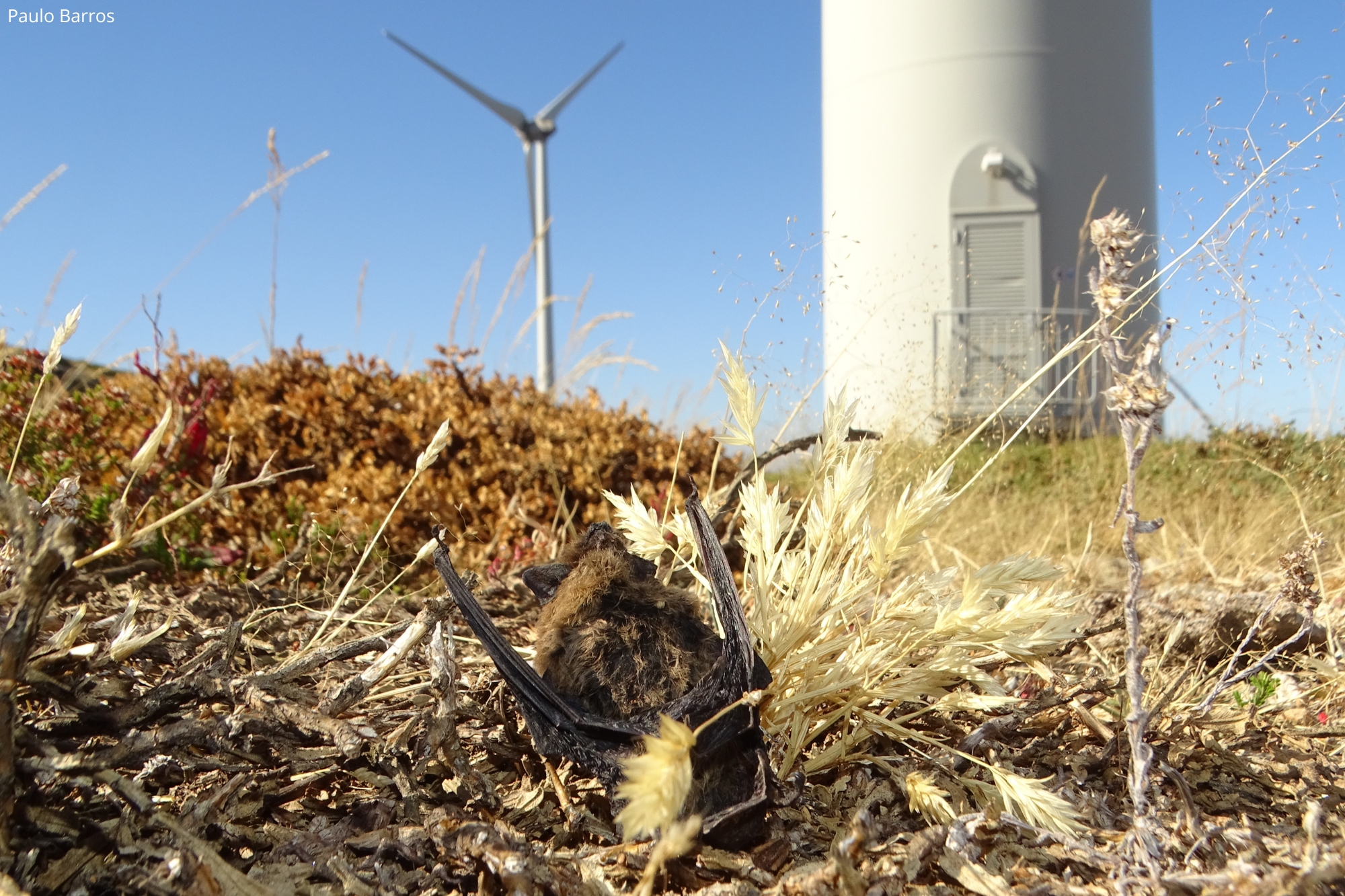
The growing number of bat incidents at wind farms and the strong growth of this energy sector in Spain led, at the end of the 2000s, to the creation of a working group within SECEMU dedicated to examining the possible impact of these facilities on bat populations in our territory and to promoting management improvements, especially those aimed at reducing bat mortality.
1. Press release.
On the occasion of the second meeting of the Conference on the Impact Assessment of Renewable Energy Projects on the Natura 2000 Network, promoted by the Ministry for the Ecological Transition and the Demographic Challenge, held in Madrid in November 2019 and in which SECEMU played a prominent role, a note was distributed to various online media and news agencies. This press release (updated in October 2020 and finally published as an opinion piece in the Journal of Bat Research & Conservation) briefly summarises the situation and can be a good introduction to the problem in Spain.
2. Wind farms in Spain.
Information about these facilities in Spain can be found on the website of the Spanish Wind Energy Association (AEE), which brings together some 200 companies and represents more than 90% of the sector. This association publishes yearbooks in which all the general information available is updated.
The Spanish government’s targets for this type of energy facility in the coming years are set out in the Integrated National Energy and Climate Plan (PNIEC) 2021-2030, to which SECEMU submitted several comments.
3. Working guidelines.
In general, studies carried out to assess the impact of wind farms on wildlife have focused almost exclusively on birds, providing very poor information on other groups of vertebrates. Sometimes the protocols for carrying out these studies are subject to legal regulations, but almost always in an overly general way and without including bats (see, for example, the sectoral plans in force in regions such as the Basque Country or Asturias, both of which have special management plans for some species). In the case of bats, the lack of information has led to proposals for carrying out studies with certain guarantees, through working protocols with mainly methodological guidance.
SPAIN:
There are no general regulations on this matter in Spain, although there are various recommendations promoted by different organisations and institutions. Until the publication in 2013 of the Directrices básicas para el estudio del impacto de instalaciones eólicas sobre poblaciones de murciélagos en España* (basic guidelines for studying the impact of wind energy facilities on bat populations in Spain), the first document specifically focused on this issue, the only proposal had been the one put forward by the Spanish Ornithological Society (SEO/BirdLife). SECEMU’s guidelines were drawn up with the aim of “… making it possible to obtain homogeneous basic information throughout the territory and, on the other hand, helping to minimise the impact of these facilities on the populations of these mammals”. Following an initiative by some regional governments, in mid-December 2020 the Ministry for the Ecological Transition and the Demographic Challenge completed a compilation and systematisation of the information that may be required for environmental impact assessments of onshore wind farms through the scoping documents drawn up by the environmental authorities. This initial proposal has given way to other, more precise and detailed guidelines, now available on the Ministry’s website.
* This document is currently under review in order to update some aspects that should be considered outdated (e.g. number of recorders per wind farm) or on which there is new, more precise scientific information.
Regional guidelines:
Given the obvious seriousness of the situation and the outdated information that companies are required to collect in environmental impact studies (in most cases only on birds), some regional governments have shown interest in extending their regulations or even establishing protocols to serve as a reference for this type of study. It is surprising that each region always tries to develop its own rules or guidelines, possibly reflecting different sensitivities towards the situation. This leads to situations as disparate as, for example, wind farms in some provinces of Andalusia (e.g. Cádiz) being searched for carcasses daily, while in northern regions, according to several officials consulted, this is considered “… unthinkable”.

Currently (mid-2021), five regions have pre-operational protocols or guidelines, established as internal rules and with clear and specific references to bats:
Navarre: the Foral Community of Navarre was the first region to develop and implement its own protocol. This protocol, distributed since the end of 2019 to developers and environmental consultancies working in the region but not yet directly available online, is based on the guidelines proposed by EUROBATS and SECEMU, simplifying some of their recommendations.
Castile and León: formalised as instruction 4/FYM/2020 (15/06/2020), it is directly based on SECEMU’s guidelines, which it also cites as a reference. This protocol also includes precise instructions for mortality monitoring, based on the use of trained dogs.
Principality of Asturias: in operation since 25/06/2020 (the date on which it appears as a reference in a document published in the region’s official gazette) and recently modified as an annex to the protocol of the Ministry for the Ecological Transition and the Demographic Challenge.
Catalonia: based on the protocol developed in Navarre. In operation since the end of 2020 but, for the moment, also not available online.
La Rioja: through its website, the regional government of La Rioja has made available to wind and solar farm developers an instruction whose annexes IV and VI specifically set out general rules to be considered for bats in studies carried out at wind farms.
EUROPE:
The EUROBATS secretariat, established under the Agreement on the Conservation of Populations of European Bats, within the framework of the Convention on the Conservation of Migratory Species of Wild Animals (Bonn Convention), to which Spain, surprisingly, has still not acceded, produced a comprehensive reference guide in 2008, updated a few years later: Guidelines for consideration of bats in wind farm projects. Revision 2014.
Many of the recommendations in the EUROBATS guidelines are also included in the guidance drawn up in 2020 by the European Commission. This guidance document on wind energy developments and EU nature legislation is not legally binding, but it is particularly important for Spain, which is not part of EUROBATS. It includes clear and up-to-date references to several aspects of particular interest in relation to bats, recommending that it be applied alongside other local guidelines (including those drawn up by SECEMU) in order to adopt appropriate and scientifically sound methods for the species, habitats and environmental conditions specific to each Member State or European region.
Other neighbouring countries (see, for example, Portugal, France and the United Kingdom) have also drawn up their own internal proposals. These proposals, and those of other European countries, are listed in one of the annexes to the European Commission document.
4. SECEMU statement on the removal of environmental impact assessment for renewable energy facilities.
The new Royal Decree-Law 20/2022 approved by the Spanish government will greatly reduce the reliability and quality of the already poor environmental impact studies for wind farms and will also prevent information on their effects on biodiversity from being obtained. This will result in higher mortality of resident and migratory bats over the coming decades, with possibly irreversible effects on the conservation of some currently protected and threatened species, which are also very sensitive to wind farms. The commission has therefore issued a statement on the removal of environmental impact assessment for renewable energy facilities (in Spanish).
5. Key references.
Below is a small selection of papers published in scientific journals that can be considered of particular interest (in preparation) on some aspects related to bats and wind farms. We have also compiled a list of publications with information available on Spain.
The scale of the problem is significant and mortality estimates for the Iberian Peninsula are certainly worrying, with average figures of between 4 and 11 dead bats per turbine per year, and well-studied cases that are likely to affect populations of listed species. In fact, since 2019 we have been reviewing various projects in the approval process, submitting comments on all of them due to the constant shortcomings in how bats are dealt with. As standard practice, these comments are also sent to the departments responsible for wildlife management and to other interested bodies.
Conference on the impact of wind farms on bats
SECEMU’s commission on wind farms and bats, in collaboration with the Ministry for the Ecological Transition and the Demographic Challenge, organised a conference on the impact of wind farms on bats, held on 7 and 8 May 2024. Its aim was to raise awareness of how wind farms affect bat populations and to help reduce the mortality of these mammals at such facilities. The conference was aimed at technical staff from Spain’s regional and central administrations, wind energy developers, environmental consultancies, environmental groups and other interested people. Speakers included professionals with experience in various fields related to the subject: SECEMU members, consultancies, researchers and staff from several administrations.
If you missed the conference, it was streamed online and you can watch it here (in Spanish):
For any questions or enquiries, you can contact us using the form below or by emailing [email protected].
