
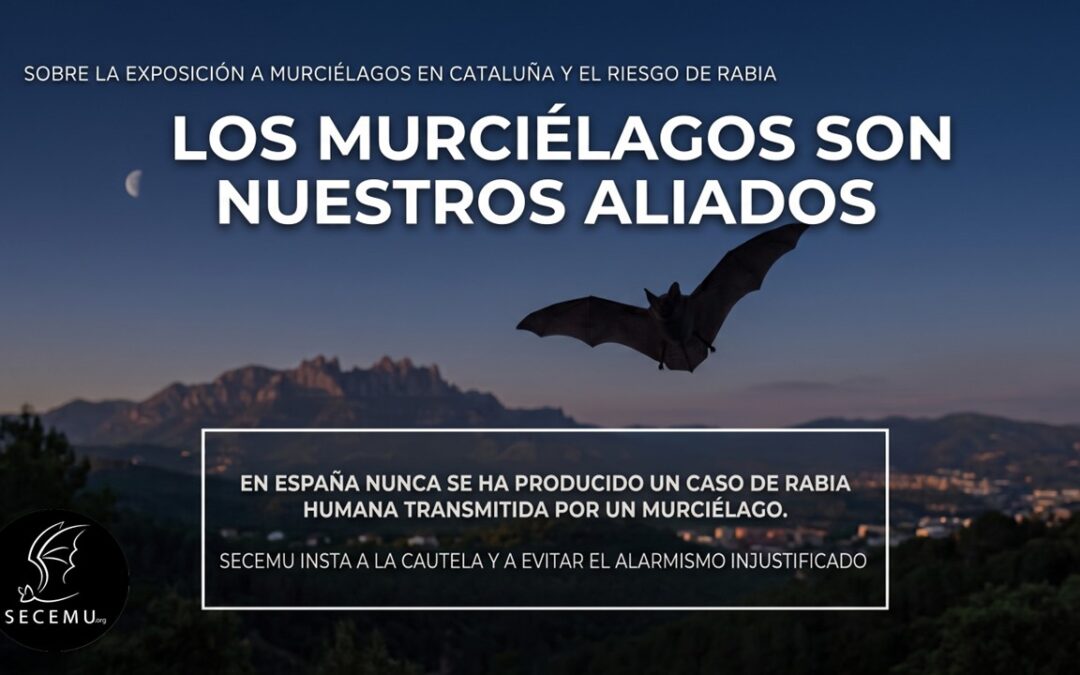
At SECEMU (the Spanish Association for the Conservation and Research of Bats) we are concerned that public health data aimed at preventing rabies is being used to stir up unwarranted alarm about bats.
To mark World Rabies Day, the health authorities of Catalonia published a press release stating that, between January and August 2026, 198 attacks by various animals and 86 incidents involving contact with bats were recorded in the region: https://govern.cat/salapremsa/notes-premsa/872580/salut-recomana-evitar-contacte-animals-paisos-rabia-endemica-mesura-prevencio-daquesta-malaltia. Although the latter figure represents a 23% increase on the total for 2025, we would point out that incidence must be assessed over sufficiently long time series and that, in this case, the variation is not statistically significant.
Following this information, several media outlets wrongly described these encounters as bat “attacks”, causing unwarranted public alarm. In response, our association wishes to make clear that bats are nocturnal, insectivorous animals protected by law, which do not attack people, as the Generalitat also points out. Contact with members of the public is always accidental and unlikely, and bites only occur as a defence mechanism when someone tries to handle them. For this reason, bats should only be handled when strictly necessary, carefully and as little as possible, always wearing thick gloves, in which case the risk of being bitten is extremely low. However, after any accidental contact with skin or mucous membranes, you should see a doctor as soon as possible so that they can assess the risk and, if necessary, prescribe preventive treatment, which is fully effective.
It is important to stress here that contact with a bat does not necessarily mean that the bat has rabies; in fact, this is not the case in more than 95% of the cases that reach the laboratory after a risky contact with the public. It is also important to distinguish clearly between the classic terrestrial rabies virus and the other lyssaviruses found in European bats. These are different viruses with different epidemiology. The former is found in a wide range of wild land mammals and in dogs, which transmit the virus in more than 99% of the over 60,000 human rabies cases estimated to occur worldwide each year; the latter are found only in bats. Indeed, we should stress that there has never been a case of human rabies transmitted by bats in Spain, and only five have been reported in Europe since historical records began. Transmission of European bat lyssaviruses to land mammals is exceptional and carries no risk of terrestrial rabies being reintroduced, as there is no mutual adaptation and, consequently, the virus does not become established in the infected animal’s population.
Far from being a threat, bats are natural controllers of agricultural pests and of populations of mosquitoes that transmit infectious diseases, saving millions in food production costs, reducing mosquito bites and cutting the use of pesticides that harm the environment and health.
Reporting driven by fear and scientific confusion only harms biodiversity and distorts expert advice. For all these reasons, SECEMU urges caution and responsible reporting. Only in this way can the necessary dissemination of official prevention campaigns achieve its aim without generating alarmist headlines that harm protected species.
For more information on bats and viruses: https://secemu.org/en/bats-and-viruses/.
